Saturday, April 5, 2014

Lots of reading and inventories in ADED 6487

Hopefully, we had our last snowfall last Sunday. I have no idea how +Richard Byrne lives in weather colder and more snowier than I prefer and still finds time to write. I am glad he finds the time, passion, and energy for his blogs and teachings.

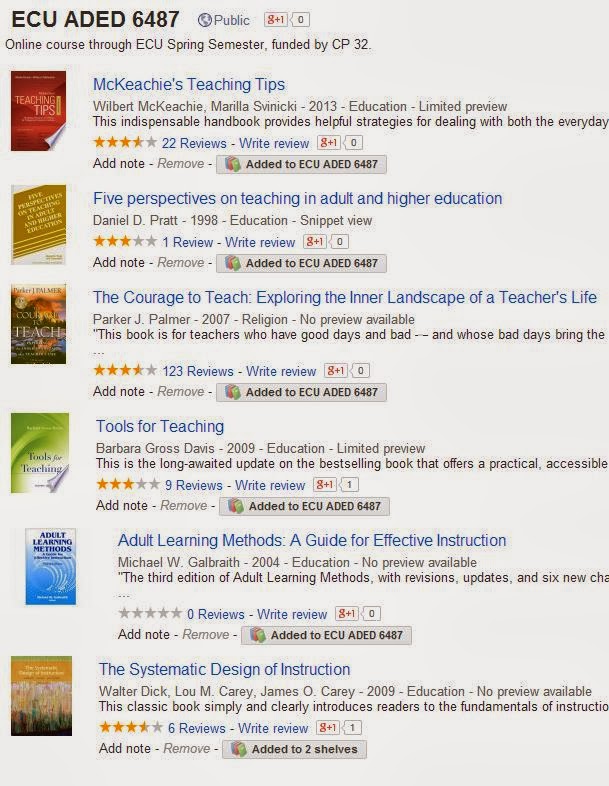
Back in January 2014, I started ADED 6487 Instructional Strategies in Adult Learning with +East Carolina University with two text books. Our professor provides supplemental reading assignments in our module challenges. The supplemental readings have lengthy bibliographies, so I bookmark a few of the referenced articles for my own additional reading. I have a Google bookshelf for this class.

So what have I been reading/doing since January? (last blog post was January 2014) 

We took the Philosophy of Adult Education Inventory (PAEI) and the Teaching Perspectives Inventory early in the course with the option to take them again at the end of the course or at any other time since the tools are available online.

In no particular order and in text format so you can convert to your required format for your own references, APA, MLA, Chicago, Turabian, and more. Asterisks indicate the required readings from the textbooks or supplemental readings.

  1. *Dick, W., Carey, L., & Carey, J. O. (2009). The systematic design of instruction. Upper Saddle River, N.J: Merrill/Pearson.
  2. *Svinicki, M. D., McKeachie, W. J., & McKeachie, W. J. (2014). McKeachie's teaching tips: Strategies, research, and theory for college and university teachers. Belmont, CA: Wadsworth, Cengage Learning.
  3. *Booth, M., & Schwartz, H. L. (2012). We're all adults here: Clarifying and maintaining boundaries with adult learners. New Directions for Teaching and Learning, 2012(131), 43-55.
  4. *May, G. L., & Short, D. (2003). Gardening in cyberspace: A metaphor to enhance online teaching and learning. Journal of Management Education, 27(6), 673-693.
  5. McWilliam, E. L. (2005). Unlearning pedagogy. Journal of Learning Design, 1(1), 1-11.
  6. Trilling, B., & Fadel, C. (2009). 21st century skills: Learning for life in our times. John Wiley & Sons.
  7. *Galbraith, M. (2004). Adult learning methods: A guide to effective instruction, 3rd ed, Malabar, FL: Krieger Publishing 
  8. *Palmer, P. (2007).  The courage to teach: Exploring the inner landscape of a teacher's life. San Francisco, CA: Jossey-Bass.
  9. *Pratt, D., & Collins, J. (2014). Teaching perspectives inventory. Retrieved from http://www.teachingperspectives.com/drupal/
  10. *Pratt, D. D. (2005). Five perspectives on teaching in adult and higher education. Malabar, Fla: Krieger Pub. Co.
  11. *Zinn, L. (1994). The philosophy of adult education inventory. Retrieved from http://www25.brinkster.com/educ605/paei_howtouse.htm
  12. *Blumberg, P. (2009). Maximizing learning through course alignment and experience with different types of knowledge. Innovative Higher Education 34, p. 93 - 103.
  13. *Weinstein, C. E., Acee, T. W., & Jung, J. (2011). Self‐regulation and learning strategies. New Directions for Teaching and Learning, 2011(126), 45-53.
  14. Swan, K., Shea, P., Fredericksen, E., Pickett, A., Pelz,W.,& Maher, G. (2000). Building knowledge building communities: Consistency, contact and communication in the virtual classroom. Journal of Education Computing Research, 23(4), 359-383.
  15. Coppola, N.W., Hiltz, S. R., & Rotter, N. G. (2002). Becoming a virtual professor: Pedagogical roles and asynchronous learning networks. Journal of Management Information Systems, 18(4), 169-189.
  16. Gardner, S., Dean, C., and McKaig, D. “Responding to D in the Classroom: The Politics of Knowledge, Class, and Sexuality.” Sociology of Education, 1989, 62, 64–74.
  17. Buck, G. A., Mast, C. M., Latta, M.A.M., and Kaftan, J. M. “Fostering a Theoretical and Practical Understanding of Teaching as a Relational Process: A Feminist Participatory Study of Mentoring a Doctoral Student.” Educational Action Research, 2009, 17(4), 505–521.
  18. Boyd, D. (2014). It's Complicated: The Social Lives of Networked Teens. New Haven: Yale University Press. http://www.danah.org/
  19. Hattie, J., Biggs, J., and Purdie, N. Effects of learning skills interventions on student learning: A meta-analysis. Review of Educational Research, 1996, 66(2), 99–136.
  20. Hofer, B. K., and Yu, S. L. Teaching self-regulated learning through a “learning-to-learn” course. Teaching of Psychology, 2003, 30(1), 30–33.
It seems that every time I went to write a blog post or even jot down my ideas, other priorities took precedence from shoveling snow, prep for a colonoscopy, the colonoscopy, a root canal, to cleaning up after a potty accident, trips to the playground, shoveling snow, completing th Making Sense of Data course, career, family....well you know how life has priorities. I am reminded while taking this course and integrating into my life that I still do not have time to return to my doctoral studies. Hat tip to all my fellow doctoral students who stayed on target and completed their research and defended their dissertation. 

If you have any recommended readings for me, feel free to comment. At least I can take the a mobile device and read when I am waiting.

Thanks,


Saturday, January 18, 2014

Instructional Strategies in Adult Education textbooks and readings

I shared previous textbooks and readings from other courses I took over the years using Google Books. The most read section is in the Instructional Design Basics bookshelf.

Every now and then funding becomes available for careerists in my field (CP 32) to participate in college courses with East Carolina University. While many careerists have some type of degree, this opportunity allows one to connect with a college in this century, hone their distance/distributive learning skills, and if they desire go through the process to pursue another degree with their own funds.

The last course I took was in the Summer 2012 session. There were no textbooks associated with EDTC 7030, Web Teaching: Design and Developmentbut I did share some homework adventures through the blog and Google+.

With ADED 6487 Instructional Strategies in Adult Education there are two required textbooks and two optional textbooks and some additional readings from designated texts selected by our professor.

So here is another shared Google Bookshelf for ADED 6487.


How are you using your Google bookshelves?
Here is to another fun learning adventure.

Tuesday, December 24, 2013

Don't forget the little things and RAOKs are OK


Merry Chrismahanukwanzakah!
Last night on the way home, a car became disabled in front of me on a busy highway. The easy thing to do would have been just to go around them...but I didn't. A young man jumped out of the driver's side, went to the passenger side and took out a baby carrier and a young lady got out of the passenger side. For a brief minute I thought it was a joke. I turned on my flashers and asked the young lady if I could call anyone. Both of them busy on the phones trying to reach someone for help. She said they were calling friends.
I called family to let them know that I was staying on the road until some type of help arrived. I called the non emergency RCSO number. The dispatcher asked was I behind the described car (apparently someone called and reported a disabled vehicle). The dispatcher said a deputy is trying to get there. As you can see, traffic was backed up for miles.

They were a young couple with a one year old. People had comments and criticism as they drove by and I wished them "Happy Holidays, hope you never have an incident". I put the young lady and the baby in the back seat to stay warm. The deputy arrived and assessed the situation, jumped the car battery but it did not stay running. He stopped an 18 wheeler to block the traffic so we could push the car off the road. I waited with the young couple until the tow truck arrived to tow the car. The baby had been great the whole time, not a whimper, just mesmerized by his surroundings and probably wondering WTF. Of course with all of the phone calls for help phone batteries died. I let them use my car charger while we waited.

Of course, with the car incident, the young lady had to call off her job for the evening. The young man said he would ride with the tow truck driver. I volunteered to drive the young lady and her child home. On the way to take them home, the baby decides to exercise his lungs. We stopped at a convenience store and picked up some juice for the baby. I said this was the least I could do since over 100,000 cars passed us and not one person offered to stop and assist. I said I wish I could do something like Ellen does for people, but I am not that well off, so a juice it will be. 

I know it is that crazy time of year, but take a minute to pay it forward. It is the little things that matter whether you say, "Thank You" or ask (and mean it) if someone is OK. They asked why did I do what I did and I told them I would hope someone would do this for my daughter, mother, or myself if our vehicles became disabled. I took the picture and told them I would do a blog post about this event. Southern hospitality? Didn't see any of it last night. Even mentioned it to the deputy and he said he is not surprised.

So take a minute this season and practice a random act of kindness (RAOK), check on a neighbor, stop and check on the young couple broke down in the middle of traffic, or choose an idea from the Random Acts of Kindness site.

Remember there's no such thing as a small act of kindness. Every act creates a ripple with no logical end. Scott Adams Creator Of Dilbert Comic Strip

Merry Chrismahanukwanzakah!